
The Geopolitical Arbitrage: Leveraging Diplomatic Acumen in Executive Management

By Gohar Hovsepyan
RKC Executive MBA Student

Introduction: When Geopolitics Becomes a Business Skill

The boundaries between geopolitics and business have never been more fluid. Companies today operate in an environment shaped not only by customers, competitors and capital, but also by sanctions, trade policy, political alliances, regulatory shifts and geopolitical risk. For professionals trained to understand international affairs, this changing landscape presents an opportunity: the skills traditionally associated with diplomacy and international relations are increasingly relevant to executive decision-making.

But translating diplomatic expertise into business leadership requires more than simply adding an MBA qualification to a CV. It requires learning to view familiar global challenges through a different lens—one that connects political insight with financial performance, organisational strategy and measurable business outcomes.

For International Relations (IR) professionals, an Executive MBA can provide precisely this bridge. RKC’s Executive MBA, for example, combines areas such as strategic management, applied leadership, sustainable finance, risk management and digital marketing with an applied business project.

In this article, RKC Executive MBA student Gohar Hovsepyan explores what happens when the analytical instincts of diplomacy meet the demands of the modern boardroom—and why the emerging “geoeconomic executive” may be uniquely equipped to navigate an increasingly interconnected world.

The Convergence of Two Worlds

For decades, statecraft and corporate strategy operated on completely different planets. One world focused on treaties, soft power, and the long view of history. The other was driven by margins, quarterly targets, and immediate returns for shareholders.

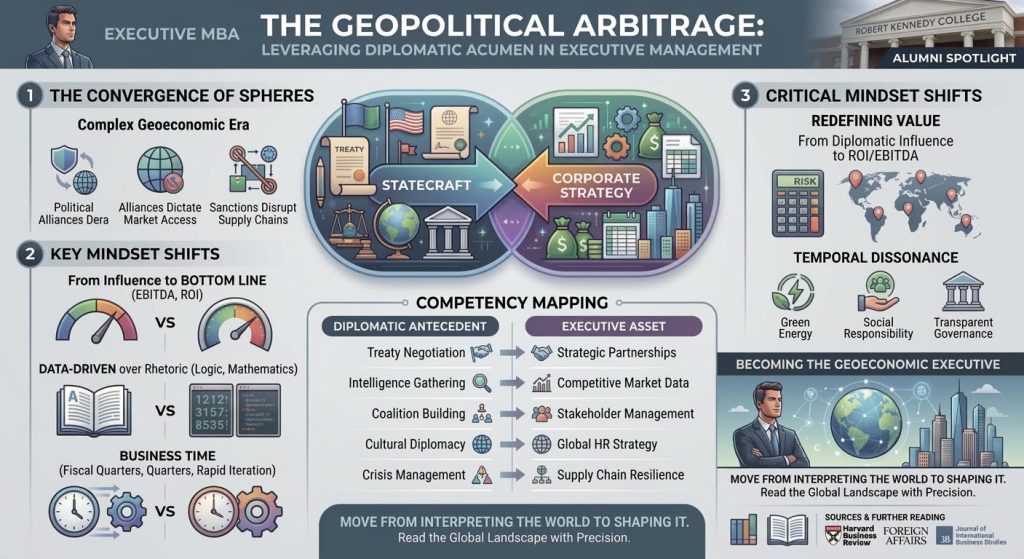
Today, those worlds are colliding. We are doing business in an era where political alliances dictate market access and sanctions regularly disrupt supply chains. For International Relations (IR) professionals, this complex “Geoeconomic Era” presents a massive opportunity. Stepping into an Executive MBA program like the one at Robert Kennedy College (RKC) isn’t just about learning new buzzwords—it’s a fundamental rewiring of how we analyze problems.

Navigating the Mindset Shift

Transitioning from a diplomatic background to business administration isn’t necessarily about the difficulty of the material; it’s about changing your orientation. Social scientists typically hit three main friction points when entering the executive suite.

From Influence to EBITDA

In diplomacy, “value” is an intangible asset, often defined by stability, influence, or peacekeeping. In business, value is rigorous and binary: it’s the bottom line.

The shift requires moving away from the language of hegemony and embracing EBITDA and ROI. While diplomats are trained in “constructive ambiguity” to keep options open and prevent conflict, business demands decisive action. Reconciling this need for nuance with the rigid demands of a spreadsheet is a significant adjustment.

Data Over Diplomacy

Diplomats lean on history, theory, and rhetoric to build a narrative. Executives lean on empirical data to drive a decision.

Facing a Financial Management module might make anyone who hasn’t touched calculus in years hesitate. But business math is essentially just codified logic. The real hurdle is learning to prioritize hard data over qualitative storytelling.

The Speed of Business

Diplomatic time is measured in decades. You build relationships and wait for policies to slowly mature. Business time is measured in fiscal quarters, demanding immediate action.

This creates temporal dissonance. Diplomats are conditioned to pause, reflect, and build consensus, while business thrives on rapid iteration and “failing fast.” In geopolitics, a failure is a crisis; in a startup, it’s just data for the next prototype.
A Strategic Simulation

The right environment makes all the difference.

  • Applied Leadership: By prioritizing critical projects over rote memorization, the program plays to an IR professional’s strengths in research synthesis and argumentation. It’s like drafting a diplomatic cable, tailored for a Board of Directors rather than the Foreign Ministry.
  • Case Studies as Crisis Management: You learn to approach business challenges with the same intensity as a geopolitical crisis. You analyze the terrain (market conditions), the actors (competitors), and the resources (capital), using diplomatic instincts to solve novel corporate complexities.
  • Global Asynchrony: Collaborating asynchronously across time zones mirrors the operational reality of a Foreign Service posting. It requires the discipline, autonomy, and cross-cultural competence that IR professionals naturally possess.

A Natural Fit for ESG

Traditional executives sometimes view Environmental, Social, and Governance (ESG) criteria as a compliance burden. For the IR professional, this is familiar terrain. With a background studying human rights regimes and environmental accords, we are uniquely positioned to operationalize sustainability not merely as public relations, but as a core component of corporate strategy.

Translating Your Skills

Success requires only the translation of existing competencies into new terminology. The asset remains constant; only the label changes.

Diplomatic AntecedentExecutive Asset
Treaty NegotiationStrategic Partnerships & Sales
Intelligence GatheringCompetitive Market Data
Coalition BuildingStakeholder Management
Cultural DiplomacyGlobal HR Strategy
Crisis ManagementSupply Chain Resilience

Becoming the Geoeconomic Executive

To my fellow International Relations professionals at RKC: this transition requires a degree of intellectual humility. You must be willing to adopt the posture of a novice in finance, despite having established expertise in policy.

However, it is important to recognize that you are not at a deficit. You are constructing a professional foundation of exceptional rarity. You are moving from interpreting the world to shaping it. The modern boardroom requires more than financial acumen. It requires a Geoeconomic Executive capable of reading the global landscape with precision.

From International Affairs to Executive Leadership

The experience described here is part of a broader question facing professionals whose careers sit at the intersection of international affairs, business and public policy: how do you turn an understanding of global systems into the ability to lead organisations within them?

That journey does not have to follow a single academic route. At Robert Kennedy College, professionals can choose from a range of postgraduate programmes designed around different aspects of contemporary leadership and global business. The portfolio includes the Executive MBA, as well as the MBA International Relations and Diplomacy, MBA International Business, MBA Risk Management, and MBA Energy and Sustainability. RKC also offers specialised master’s programmes in areas including global management, project management, procurement, logistics and supply chain management, finance, data analytics and information systems management.

For professionals coming from diplomacy or international relations, the value of this broader academic ecosystem is the opportunity to build on existing expertise rather than leave it behind. An IR professional can deepen their understanding of business through an Executive MBA; someone seeking to retain a strong international-affairs focus can explore an MBA in International Relations and Diplomacy; others may choose to develop more specialised expertise in sustainability, risk, finance, technology or global management.

The common thread is the ability to connect global context with organisational action. As geopolitical considerations increasingly influence investment, supply chains, regulation, sustainability and market strategy, professionals who can understand both sides of that equation are positioned to bring a distinctive perspective to executive decision-making.

The future of management may therefore belong not to specialists who understand only business or only geopolitics, but to leaders capable of translating between the two.

For the aspiring Geoeconomic Executive, the challenge is not to abandon diplomacy for business. It is to add a new language to an existing professional vocabulary—and use both to understand and shape the increasingly interconnected world of modern organisations.

Sources & Further Reading

For those interested in the intersection of statecraft, geoeconomics, and corporate strategy, the following curated list offers both foundational theory and modern application.

Essential Books

  • Chip War by Chris Miller (2022): The definitive case study of how supply chains, business strategy, and national security are inextricably linked.
  • Connectography by Parag Khanna (2016): A visual and analytical guide to how infrastructure and economics are replacing traditional borders.
  • War by Other Means by Robert D. Blackwill & Jennifer M. Harris (2016): Essential for understanding how nations use economic instruments to achieve geopolitical goals.
  • Diplomacy by Henry Kissinger (1994) & The Prince by Niccolò Machiavelli (1532): Foundational texts on the balance of power, the “Long View,” and stakeholder management dynamics.
  • Thinking, Fast and Slow by Daniel Kahneman (2011): Critical for understanding cognitive biases in diplomatic negotiations and executive decision-making.

Key Journals

  • Harvard Business Review (HBR): Search specifically for articles by the Institute for Strategy and Competitiveness on “Corporate Diplomacy” or “Geopolitical Risk.”
  • Foreign Affairs: The premier magazine for analysis of international relations, often featuring essays by CEOs on the “Business of Statecraft.”
  • Journal of International Business Studies (JIBS): For peer-reviewed, empirical research on multinational enterprise strategy and cross-cultural management.

The AI-Ready Manager: 10 Things Every Business Leader Should Learn Before Using AI at Work

A few years ago, if artificial intelligence came up in a business meeting, the conversation would quickly turn technical. People would talk about algorithms, machine learning and data scientists.

That has changed.

Today, AI is appearing in ordinary workplaces. A marketing manager uses it to develop campaign ideas. Someone in finance uses it to analyse information. A manager uses it to prepare a report or explore a business problem. An executive uses it to make sense of a large amount of information before a meeting.

The interesting question is no longer whether businesses will use AI. Many already are.

The harder question is whether managers know how to use it well.

Being an AI-ready manager doesn’t mean becoming a programmer. It means knowing enough about AI to recognise where it can help, understanding its limitations, and making sensible decisions about how to introduce it into an organisation.

Here are ten things worth learning.

1. Start with the basics of AI

You don’t need to understand the mathematics behind an AI model. But if you’re going to make decisions about AI, you should have a basic understanding of what you’re dealing with.

What is machine learning? What is natural language processing? What is automation? How do these technologies relate to the AI applications businesses use today?

A manager doesn’t need to become an AI specialist, but understanding the principles makes it easier to have sensible conversations with technology teams and evaluate how AI might apply to a real business problem.

A programme to consider: RKC’s MSc Managing AI in Business includes Principles of AI, which explores the AI ecosystem, machine learning, neural networks, emerging AI architectures and the development of AI concepts.

2. Don’t look for places to use AI. Look for problems to solve.

Businesses are tempted to adopt new technology because everyone else seems to be doing it.

AI is particularly prone to this. If a competitor is using it, you should use it too.

Not necessarily.

A better place to start is with a problem. Perhaps a business needs to use its data better. Perhaps an organisation wants to improve a particular process. Perhaps there is an opportunity to use AI in a marketing activity or to support decision-making.

The question isn’t simply, “How can we use AI?”

It’s “Is there a business problem that AI could help us address?”

That distinction matters. Good management has always been about matching resources and technology to real business needs. AI doesn’t change that.

A programme to consider: The MBA Artificial Intelligence at RKC includes an Artificial Intelligence module that examines how AI concepts, including machine learning, can be applied to real-life business problems and applications.

3. Learn how to work effectively with AI

Many people have tried an AI tool once, asked it a question, received a mediocre answer, and decided the technology wasn’t very useful.

Often, the problem is how you ask the question.

Working effectively with generative AI takes practice. Providing the system with context, explaining what you are trying to achieve, and refining the result can make a considerable difference.

It is also important to know what AI can and cannot do. An AI-generated answer is not automatically reliable simply because it is well written.

This is becoming a practical professional skill: knowing how to use AI tools, evaluate their outputs, and incorporate them into your work while retaining human judgement.

A programme to consider: RKC’s MSc Strategic Leadership with AI includes AI for Business and Professional Practice, covering AI literacy, prompt design, AI-assisted research, source checking, reliability and bias, and AI-supported decision-making with human judgement.

4. Don’t believe everything AI tells you

This may be the most important lesson of all.

AI responses can sound extremely confident—even when they are wrong.

That matters in a business context. If an AI system produces inaccurate information and nobody checks it, the problem can quickly become a business issue.

Managers therefore need to develop the habit of questioning AI-generated information, particularly when it supports important decisions.

This doesn’t mean distrusting AI. It means understanding its limitations.

The ability to check sources, recognise unreliable information, and distinguish between useful assistance and an answer that needs further investigation is increasingly important.

A programme to consider: The MSc Digital Marketing with AI includes AI for Business and Professional Practice, covering source checking, hallucinations, reliability, and bias. These are useful concepts for anyone who expects to use AI in their professional work, not only those working in marketing.

5. Understand the ethical side of AI

Sometimes “Can we do this?” isn’t the same as “Should we do this?”

AI can influence decisions affecting employees, customers and other stakeholders. That raises questions about bias, trust, transparency and accountability.

Consider an organisation using AI to support workplace decision-making. How should the results be evaluated? How much trust should be placed in the system? Where does human responsibility begin and end?

These are management questions as much as they are technology questions.

An AI-ready manager needs to be comfortable thinking about AI’s wider implications, rather than focusing only on what the technology can do.

A programme to consider: RKC’s MSc Managing AI in Business includes AI in Practice, which examines regulatory frameworks and ethical considerations, and Principles of AI, which explores bias and trust in AI systems. Its Sustainable Business and Responsible Technology module also examines ethical leadership and responsible technology adoption.

6. Understand how AI fits into business transformation

Introducing AI into an organisation isn’t simply about buying a new tool.

It can change processes, responsibilities and the way people work. It can also meet resistance, particularly when employees aren’t sure why the change is happening or how it will affect them.

This is where the manager’s role becomes particularly important.

Someone has to look beyond the technology and consider how AI fits into the organisation as a whole.

What needs to change? How will people respond? How should the organisation approach adoption? What does successful integration look like?

A programme to consider: RKC’s MSc Managing AI in Business includes AI and Business Transformation, which covers AI adoption, digital mindset, leadership, organisational culture and managing resistance to AI integration.

7. Pay attention to how AI is changing people’s work

The question “Will AI take my job?” attracts a lot of attention.

For a manager, a more useful question is:

Which parts of people’s work are likely to change?

AI is already reshaping how employees interact with information and technology. Some activities may be automated, while others may require new skills or different responsibilities.

This poses a management challenge. Employees need to understand how AI affects their work, and managers need to consider employee well-being and the human side of AI adoption.

The future of work is unlikely to be simply humans versus machines. In many workplaces, people will work alongside increasingly capable technologies.

A programme to consider: RKC’s MSc Managing AI in Business addresses the role of AI in workplace decision-making and employee wellbeing in AI in Practice, while AI and Business Transformation examines leadership, culture and resistance to AI integration.

8. Learn to make better decisions with data and AI

AI and data are closely connected.

For managers, the challenge isn’t necessarily to become a data scientist. It is to understand how data and AI can support better business decisions.

That means becoming familiar with concepts such as business intelligence, data modelling, predictive analytics, and using data to identify patterns and support decision-making.

The more data-driven organisations become, the more important it is for managers to understand how those insights are produced and used.

A programme to consider: RKC’s MSc Business Analytics and Artificial Intelligence is particularly relevant here. Its modules include Data-Powered Decision Making, covering big data management, business intelligence, data modelling, and industry-specific AI applications, and Leading with Analytics and AI, which covers predictive analytics and AI-supported strategic decision-making.

9. Don’t confuse using AI with getting value from AI

Organisations can fall into a simple trap: confusing using AI with getting value from AI.

Having employees experiment with an AI tool doesn’t necessarily mean the organisation is benefiting.

A better question is: what has changed?

Has the organisation improved its decision-making? Has AI helped address a real business challenge? Has it contributed to a more effective process? Has the organisation successfully integrated it?

These questions bring us back to management.

Technology provides possibilities. Managers still have to decide how those possibilities fit into the organisation.

A programme to consider: RKC’s MSc Business Analytics and Artificial Intelligence includes the Future Leaders’ Challenge, which focuses on real-world business challenges, strategic thinking, innovation and digital transformation planning. Its Impact Project gives students the opportunity to apply their learning to a real-world business challenge.

10. Accept that you’ll never be “finished” learning about AI

Perhaps the most frustrating—and exciting—thing about AI is that it keeps evolving.

A tool you learn to use today may look very different a year from now. New applications will emerge, businesses will discover new uses for AI, and our understanding of its implications will continue to develop.

There won’t be a point at which a manager can say, “I’ve completed my AI training. That’s done.”

Continuous learning is becoming part of the job.

For some professionals, that may mean keeping up with developments through reading and experimentation. For others, postgraduate study can provide a more structured way to deepen their knowledge while connecting AI to their particular area of professional interest.

RKC now offers several programmes that take this approach from different angles. The MSc Managing AI in Business focuses specifically on AI, business transformation and responsible technology. The MSc Business Analytics and Artificial Intelligence combines AI with data and decision-making. The MBA Artificial Intelligence approaches AI from a broader management perspective. There are also specialist programmes, including the MSc Strategic Leadership with AI, MSc Digital Marketing with AI, MSc People Management with AI and MSc Finance with AI.

The right choice depends largely on where you are in your career and how you expect AI to affect your specific area of work.

The AI-ready manager

People often think becoming “AI-ready” means knowing how to use the latest AI tools.

I don’t think it’s quite that simple.

An AI-ready manager can look at a new technology and ask sensible questions.

What problem does this solve? How could it affect our organisation? What happens to our people? How reliable are the results? What are the ethical implications? And ultimately, will this make the business better?

Those questions require something AI can’t provide on its own: judgement.

That may be one of the biggest lessons of the AI revolution. The more capable the technology becomes, the more important good leadership may be.

Business leaders don’t need to compete with AI. They need to understand it well enough to make the most of it—while knowing when to step in and say, “Let’s stop and think about this.” In my view, that is what being an AI-ready manager really means.