By Gohar Hovsepyan
RKC Executive MBA Student
Introduction: When Geopolitics Becomes a Business Skill
The boundaries between geopolitics and business have never been more fluid. Companies today operate in an environment shaped not only by customers, competitors and capital, but also by sanctions, trade policy, political alliances, regulatory shifts and geopolitical risk. For professionals trained to understand international affairs, this changing landscape presents an opportunity: the skills traditionally associated with diplomacy and international relations are increasingly relevant to executive decision-making.
But translating diplomatic expertise into business leadership requires more than simply adding an MBA qualification to a CV. It requires learning to view familiar global challenges through a different lens—one that connects political insight with financial performance, organisational strategy and measurable business outcomes.
For International Relations (IR) professionals, an Executive MBA can provide precisely this bridge. RKC’s Executive MBA, for example, combines areas such as strategic management, applied leadership, sustainable finance, risk management and digital marketing with an applied business project.
In this article, RKC Executive MBA student Gohar Hovsepyan explores what happens when the analytical instincts of diplomacy meet the demands of the modern boardroom—and why the emerging “geoeconomic executive” may be uniquely equipped to navigate an increasingly interconnected world.
The Convergence of Two Worlds
For decades, statecraft and corporate strategy operated on completely different planets. One world focused on treaties, soft power, and the long view of history. The other was driven by margins, quarterly targets, and immediate returns for shareholders.
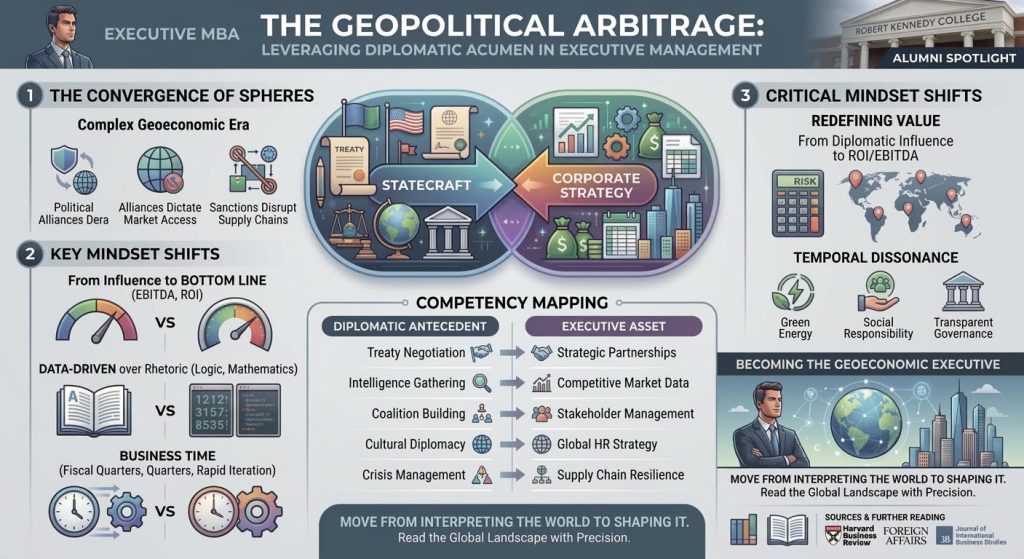
Today, those worlds are colliding. We are doing business in an era where political alliances dictate market access and sanctions regularly disrupt supply chains. For International Relations (IR) professionals, this complex “Geoeconomic Era” presents a massive opportunity. Stepping into an Executive MBA program like the one at Robert Kennedy College (RKC) isn’t just about learning new buzzwords—it’s a fundamental rewiring of how we analyze problems.
Navigating the Mindset Shift
Transitioning from a diplomatic background to business administration isn’t necessarily about the difficulty of the material; it’s about changing your orientation. Social scientists typically hit three main friction points when entering the executive suite.
From Influence to EBITDA
In diplomacy, “value” is an intangible asset, often defined by stability, influence, or peacekeeping. In business, value is rigorous and binary: it’s the bottom line.
The shift requires moving away from the language of hegemony and embracing EBITDA and ROI. While diplomats are trained in “constructive ambiguity” to keep options open and prevent conflict, business demands decisive action. Reconciling this need for nuance with the rigid demands of a spreadsheet is a significant adjustment.
Data Over Diplomacy
Diplomats lean on history, theory, and rhetoric to build a narrative. Executives lean on empirical data to drive a decision.
Facing a Financial Management module might make anyone who hasn’t touched calculus in years hesitate. But business math is essentially just codified logic. The real hurdle is learning to prioritize hard data over qualitative storytelling.
The Speed of Business
Diplomatic time is measured in decades. You build relationships and wait for policies to slowly mature. Business time is measured in fiscal quarters, demanding immediate action.
This creates temporal dissonance. Diplomats are conditioned to pause, reflect, and build consensus, while business thrives on rapid iteration and “failing fast.” In geopolitics, a failure is a crisis; in a startup, it’s just data for the next prototype.
A Strategic Simulation
The right environment makes all the difference.
- Applied Leadership: By prioritizing critical projects over rote memorization, the program plays to an IR professional’s strengths in research synthesis and argumentation. It’s like drafting a diplomatic cable, tailored for a Board of Directors rather than the Foreign Ministry.
- Case Studies as Crisis Management: You learn to approach business challenges with the same intensity as a geopolitical crisis. You analyze the terrain (market conditions), the actors (competitors), and the resources (capital), using diplomatic instincts to solve novel corporate complexities.
- Global Asynchrony: Collaborating asynchronously across time zones mirrors the operational reality of a Foreign Service posting. It requires the discipline, autonomy, and cross-cultural competence that IR professionals naturally possess.
A Natural Fit for ESG
Traditional executives sometimes view Environmental, Social, and Governance (ESG) criteria as a compliance burden. For the IR professional, this is familiar terrain. With a background studying human rights regimes and environmental accords, we are uniquely positioned to operationalize sustainability not merely as public relations, but as a core component of corporate strategy.
Translating Your Skills
Success requires only the translation of existing competencies into new terminology. The asset remains constant; only the label changes.
| Diplomatic Antecedent | Executive Asset |
| Treaty Negotiation | Strategic Partnerships & Sales |
| Intelligence Gathering | Competitive Market Data |
| Coalition Building | Stakeholder Management |
| Cultural Diplomacy | Global HR Strategy |
| Crisis Management | Supply Chain Resilience |
Becoming the Geoeconomic Executive
To my fellow International Relations professionals at RKC: this transition requires a degree of intellectual humility. You must be willing to adopt the posture of a novice in finance, despite having established expertise in policy.
However, it is important to recognize that you are not at a deficit. You are constructing a professional foundation of exceptional rarity. You are moving from interpreting the world to shaping it. The modern boardroom requires more than financial acumen. It requires a Geoeconomic Executive capable of reading the global landscape with precision.
From International Affairs to Executive Leadership
The experience described here is part of a broader question facing professionals whose careers sit at the intersection of international affairs, business and public policy: how do you turn an understanding of global systems into the ability to lead organisations within them?
That journey does not have to follow a single academic route. At Robert Kennedy College, professionals can choose from a range of postgraduate programmes designed around different aspects of contemporary leadership and global business. The portfolio includes the Executive MBA, as well as the MBA International Relations and Diplomacy, MBA International Business, MBA Risk Management, and MBA Energy and Sustainability. RKC also offers specialised master’s programmes in areas including global management, project management, procurement, logistics and supply chain management, finance, data analytics and information systems management.
For professionals coming from diplomacy or international relations, the value of this broader academic ecosystem is the opportunity to build on existing expertise rather than leave it behind. An IR professional can deepen their understanding of business through an Executive MBA; someone seeking to retain a strong international-affairs focus can explore an MBA in International Relations and Diplomacy; others may choose to develop more specialised expertise in sustainability, risk, finance, technology or global management.
The common thread is the ability to connect global context with organisational action. As geopolitical considerations increasingly influence investment, supply chains, regulation, sustainability and market strategy, professionals who can understand both sides of that equation are positioned to bring a distinctive perspective to executive decision-making.
The future of management may therefore belong not to specialists who understand only business or only geopolitics, but to leaders capable of translating between the two.
For the aspiring Geoeconomic Executive, the challenge is not to abandon diplomacy for business. It is to add a new language to an existing professional vocabulary—and use both to understand and shape the increasingly interconnected world of modern organisations.
Sources & Further Reading
For those interested in the intersection of statecraft, geoeconomics, and corporate strategy, the following curated list offers both foundational theory and modern application.
Essential Books
- Chip War by Chris Miller (2022): The definitive case study of how supply chains, business strategy, and national security are inextricably linked.
- Connectography by Parag Khanna (2016): A visual and analytical guide to how infrastructure and economics are replacing traditional borders.
- War by Other Means by Robert D. Blackwill & Jennifer M. Harris (2016): Essential for understanding how nations use economic instruments to achieve geopolitical goals.
- Diplomacy by Henry Kissinger (1994) & The Prince by Niccolò Machiavelli (1532): Foundational texts on the balance of power, the “Long View,” and stakeholder management dynamics.
- Thinking, Fast and Slow by Daniel Kahneman (2011): Critical for understanding cognitive biases in diplomatic negotiations and executive decision-making.
Key Journals
- Harvard Business Review (HBR): Search specifically for articles by the Institute for Strategy and Competitiveness on “Corporate Diplomacy” or “Geopolitical Risk.”
- Foreign Affairs: The premier magazine for analysis of international relations, often featuring essays by CEOs on the “Business of Statecraft.”
- Journal of International Business Studies (JIBS): For peer-reviewed, empirical research on multinational enterprise strategy and cross-cultural management.