Exploring the New Online MSc Artificial Intelligence and MBA: Key Highlights from the February 2026 Info Session

On 19 February 2026, prospective students from around the world joined an engaging online information session introducing two forward-looking programmes: the Online MSc in Artificial Intelligence and the Online MBA. The session was presented by Dean David Costa, who shared valuable insights into the programmes, the learning approach, and the international academic partnerships that make these qualifications globally respected.

The session provided an excellent opportunity for participants to understand how flexible, online postgraduate education can support career progression in today’s rapidly evolving professional landscape.

A Welcome from Dean David Costa

The session opened with remarks from Dean David Costa, who highlighted the growing importance of advanced education in fields such as artificial intelligence, data-driven decision-making, and strategic leadership.

He emphasized that modern professionals increasingly require both technical knowledge and managerial expertise to remain competitive in global industries. Online learning models, when designed effectively, enable working professionals to gain these competencies without interrupting their careers.

Dean David Costa also introduced the academic philosophy behind the programmes:

  • Flexible online learning
  • Practical and industry-relevant curriculum
  • International academic collaboration
  • Support for a global student community

The MSc in Artificial Intelligence: Preparing for the Future of Technology

One of the highlights of the session was the introduction of the Online MSc in Artificial Intelligence, a programme designed for professionals interested in developing advanced expertise in AI technologies and applications.

Key Focus Areas

The MSc programme explores core areas of modern artificial intelligence, including:

  • Machine learning and deep learning
  • Data analytics and intelligent systems
  • AI ethics and responsible technology development
  • Applications of AI in business and industry

Students gain both theoretical understanding and practical skills, enabling them to design and implement intelligent systems that can solve real-world problems.

The Online MBA: Developing Global Business Leaders

The information session also introduced the Online MBA programme, designed for professionals aiming to advance into leadership and management roles.

Programme Highlights

The MBA curriculum focuses on key areas of strategic management and organizational leadership, including:

  • Strategic management and leadership
  • Financial decision-making
  • Global business environment
  • Marketing strategy
  • Digital transformation and innovation

The programme encourages students to apply theory directly to real business challenges, helping them develop the strategic thinking required in modern organizations.

Who the MBA is Designed For

The MBA programme is ideal for:

  • Mid-career professionals seeking leadership roles
  • Entrepreneurs and business founders
  • Managers looking to strengthen strategic decision-making skills
  • Professionals transitioning into management

Through case studies, research, and collaborative learning, students develop a holistic understanding of business operations and strategy.

International Academic Partnerships

A key strength of the programmes discussed during the session is the academic partnership with respected UK universities. Through these collaborations, students benefit from internationally recognized degrees while studying through a flexible online format.

These partnerships ensure that:

  • The curriculum meets high academic standards
  • Degrees are globally recognized
  • Students receive rigorous academic support and supervision

By combining Swiss-based online education delivery with UK university accreditation, the programmes offer students a truly international educational experience.

Watch the Event Recording

For those who were unable to attend the live session, the event recording provides a detailed overview of both programmes, including admissions information, programme structure, and career benefits.

The recording offers prospective students the opportunity to hear directly from the dean and learn how these programmes can support their professional ambitions.

The Online information session highlighted how postgraduate education is evolving to meet the needs of a digital and global workforce. Programmes such as the Online MSc in Artificial Intelligence and the Online MBA combine academic rigor with flexibility, allowing professionals to develop advanced expertise while continuing their careers.

As industries continue to be transformed by technology, data, and innovation, programmes that integrate technical knowledge with strategic leadership skills will play an increasingly important role in shaping the next generation of global professionals.

Changing Lives Through MBA Educational Leadership: Empowering Educators for Management and Leadership Roles

Why Educational Leadership Matters More Than Ever

Education systems across the world are undergoing rapid transformation. Digital delivery, inclusive education practices, and the demand for lifelong learning have reshaped what it means to be an effective educator today. Increasingly, teachers and academic professionals are stepping into leadership and management roles to shape these changes at an institutional level.

An MBA in Educational Leadership offers educators the opportunity to extend their impact beyond the classroom — developing strategic, managerial, and leadership capabilities needed to lead modern educational organisations.

Delivered by the University of Cumbria in collaboration with Robert Kennedy College (RKC), this programme is designed specifically for educators seeking leadership roles in a global education environment.

Why Choose an MBA in Educational Leadership?

Unlike traditional education degrees, an MBA in Educational Leadership combines educational theory with business and leadership practice. This approach prepares graduates to:

  • Lead schools, colleges, universities, and training organisations
  • Manage people, budgets, and institutional change
  • Align educational strategy with global trends and policy shifts
  • Improve student outcomes through effective leadership

For educators aspiring to roles such as academic manager, programme leader, school administrator, education consultant, or policy advisor, this qualification provides both credibility and practical skills.

University of Cumbria and Robert Kennedy College: A Global Partnership

The MBA in Educational Leadership is awarded by the University of Cumbria (UK) and delivered online through Robert Kennedy College, based in Switzerland. This partnership combines British academic standards with flexible, international online delivery. According to industry rankings, the University of Cumbria is #1 in the UK for producing business leaders (in Novuna’s Degrees that Lead to Leadership study) and #8 worldwide for quality education in the Times Higher Education Impact Rankings. 

Key benefits of studying through RKC include:

  • 100% online learning via a structured virtual campus
  • Flexible study options designed for working professionals
  • An international student cohort, offering global perspectives
  • British degree recognition with worldwide relevance

This collaborative model reflects modern higher education delivery — accessible, inclusive, and globally connected.

Programme Modules: What Educators Learn

The MBA in Educational Leadership curriculum is structured to develop strategic, ethical, and people-focused leaders in education.

Core Modules

  • Organisational Behaviour
    Understand how individuals and teams function within educational organisations.
  • Marketing Management
    Learn how educational institutions position themselves, communicate value, and respond to stakeholder needs.
  • Models and Theories of Educational Leadership
    Explore leadership frameworks specific to educational contexts, grounded in research and practice.
  • Enterprise Ethics and Sustainability
    Develop responsible leadership approaches aligned with ethical and sustainable education systems.
  • Strategic Management
    Gain the skills to lead change, manage complexity, and make long-term strategic decisions.

Elective Modules

Students choose electives such as:

  • Financial Management
  • Money Management

These modules are particularly valuable for educators moving into senior leadership roles involving budgeting, funding, and resource planning.

Dissertation

The programme concludes with a research-based dissertation, allowing students to investigate a real-world educational leadership issue relevant to their professional context.

Supporting Global Teaching Trends

Blended and Online Learning

The programme’s online delivery mirrors the global shift toward blended and digital education, preparing leaders to design, manage, and evaluate flexible learning models within their institutions.

Inclusive Education

Learning within an international cohort encourages cultural awareness and inclusive leadership practices — essential for supporting diverse student populations and equitable education systems.

Lifelong Learning

By returning to study themselves, educators embody the principle of lifelong learning, strengthening their ability to foster learning cultures within their organisations.

Career Pathways After an MBA in Educational Leadership

Graduates of the MBA in Educational Leadership are well-positioned for roles such as:

  • Academic or Programme Manager
  • School or College Administrator
  • Education Consultant
  • Learning and Development Manager
  • Policy and Education Strategy Advisor

The programme supports both career progression and professional transformation, enabling educators to influence education at scale.

From Educator to Education Leader

Education leaders play a critical role in shaping the future of learning. The MBA in Educational Leadership from the University of Cumbria, delivered in collaboration with Robert Kennedy College, equips educators with the strategic insight, leadership capability, and global perspective required to lead confidently in a changing world.

For educators seeking leadership or management roles, this programme is more than a qualification — it is a pathway to greater impact, influence, and professional growth.

How to Get the Most Out of Your Online Master’s Programme from Robert Kennedy College

Leveraging Resources and Opportunities

Embarking on a master’s program is a significant milestone in your academic and professional journey. This period is replete with opportunities to expand your knowledge, develop new skills, and lay the groundwork for your future career. To ensure you make the most of this experience, it is essential to strategically utilize the resources and opportunities available to you. It’s a time filled with opportunities to learn, grow, and set the stage for your future career. But how do you ensure you’re making the most of this experience? Let’s explore some strategies to help you thrive.

1. Get to know your team

Building a genuine connection with your Faculty and Studentcare is key. They’re experts, mentors, and often the first people who can offer guidance on your academic journey. 

By actively participating in class discussions, you’re not only deepening your understanding of the subject matter but also opening doors to future recommendations. Think of it as nurturing a relationship: the more sincere and engaged you are, the more rewarding the connection becomes.

2. Plan your studies efficiently

Planning your studies efficiently is the foundation of academic success. Begin by reviewing the curriculum to understand the course structure and requirements, which will help you tailor a study schedule that fits your needs. Create a dedicated study plan that sets aside time each week for readings, assignments, and online discussions. Additionally, using a calendar to track deadlines for assignments, projects, and discussions ensures that you stay organized and on top of your coursework.

3. Take advantage of Online Campus Resources

To deepen your understanding, it’s important to venture beyond the provided reading list and explore additional materials. This extra effort can significantly broaden your perspective on the subject. Additionally, take full advantage of the University online library, which offers a wealth of academic resources that can supplement your studies. Staying updated by following industry trends and regularly reviewing academic journals in your field further ensures that your knowledge remains current and relevant, ultimately enhancing both your academic and professional growth.

4. Network, Network, Network

Building a robust professional network is an essential part of your journey. By joining alumni networks, you can connect with RKC graduates who offer valuable insights to potential careers

Additionally, leveraging platforms like LinkedIn to share your academic achievements helps you build a presence in your industry and engage with professionals who can offer further guidance. Keep an eye out for career advancement opportunities—whether that means seeking promotions, exploring new job roles, or even embarking on entrepreneurial ventures—so that you can put your newly acquired knowledge into action.

5. Get involved in Research

Research experience is invaluable, whether you’re planning to go into academia or industry. Engaging in research is an excellent way to enhance your master’s program experience. Research opportunities allow you to develop critical thinking skills, learn new methodologies, and contribute to your field through publications. Taking initiative and demonstrating a keen interest in your work can lead to significant academic and professional advancements. It helps you develop critical thinking skills, learn new methodologies, and can even lead to publications.

6. Apply Learning to Real Life

Integrating theory with practice is essential for bridging academic learning and professional application. By using case studies, you can connect theoretical concepts to practical business scenarios, making abstract ideas more tangible. At Robert Kennedy College ,we have an option to work  on real-life projects, especially those that align with your current work challenges, ensures that your assignments are both relevant and immediately applicable. This approach allows you to implement your learnings directly at work, improving your professional skills and enhancing your decision-making capabilities while reinforcing your academic insights.

7. Balance is Key

Remember, balance is key. While focusing on your studies is important, it’s equally crucial to take care of yourself. Maintaining a healthy work-life balance is essential for your overall well-being and academic success. Utilize a planner or digital calendar to organize your tasks and commitments, ensuring you allocate time for both work and relaxation. Regular exercise, social activities, and hobbies can help you manage stress and maintain a well-rounded lifestyle.

8. Plan for the Future

Planning for the future is essential, and it’s never too early to start.  Whether you aspire to pursue a Doctorate, enter the workforce, change jobs or start your own business, having a clear plan can help you make the most of your time in the program. Setting both short-term and long-term goals and beginning to build your professional portfolio are key steps that not only prepare you for the next phase of your career but also ensure that your academic journey is both purposeful and rewarding.

So, there you have it! With these strategies, you’ll be well on your way to making the most of your master’s program. Making the most of  RKC’s master’s program involves a strategic approach to utilizing resources and seizing opportunities. Remember, it’s not just about earning the degree—it’s about the journey, the learning experiences, and the connections you make along the way. By staying disciplined, engaging actively, and applying your learning to real-world situations, you can truly maximize the benefits of your Master’s from RKC.

Would you like personalised advice from our education advisors? Chat with them live now.

Building a Smarter Academic Future: A New Year’s Resolution Guide to Success

The beginning of a new year offers a fresh opportunity to reassess your goals and chart a path toward academic success. Whether you’re a university freshman navigating the challenges of college life or a
mature student looking to enhance your academic performance, setting smart and actionable resolutions can make all the difference.

This guide will walk you through the steps to build a smarter academic future.

Reflect on Your Past Year

Before you set new resolutions, take a moment to reflect on the past year. What were
your biggest achievements? Where did you struggle? Understanding your strengths and
weaknesses ( areas of improvement ) will help you create more effective goals.
Ask Yourself:
o What worked well for me academically?
o What challenges did I face?
o How did I manage my time and energy?

Set SMART Goals

To build a successful academic future, your resolutions should be SMART: Specific, Measurable, Achievable, Relevant, and Time-bound. For example:

  • Vague Goal: “I want to get better grades.”
  • SMART Goal: “I will improve my GPA from 3.0 to 3.5 by the end of the spring semester by dedicating 10 extra hours per week to studying and seeking help in challenging subjects.”

Break your goals into smaller milestones to track progress and stay motivated.

Prioritize Time Management

Effective time management is crucial for academic success. Use tools like planners, apps, or digital calendars to organize your schedule. Allocate time for:

  • Classes and Labs: Ensure you’re punctual and prepared.
  • Study Sessions: Block out regular, distraction-free study time.
  • Self-Care: Balance your academics with rest, exercise, and hobbies.

Pro Tip: Follow the “Pomodoro Technique,” where you focus for 25 minutes and then take a 5-minute break. This can improve productivity and prevent burnout.

Build Strong Study Habits

Good study habits are the foundation of academic success. Here are some strategies:

  • Active Learning: Engage with the material by summarizing notes, creating mind maps, or teaching the concepts to others.
  • Consistent Review: Don’t cram! Review material weekly to reinforce learning.
  • Seek Help Early: Don’t hesitate to approach professors, teaching assistants, or tutors when you’re stuck.

Stay Organized

An organized student is a successful student. Keep track of your assignments, deadlines, and exam dates. Use tools like:

  • A physical or digital planner.
  • Note-taking apps like Notion, Evernote, or OneNote.
  • Cloud storage (e.g., Google Drive) for easy access to study materials.

Develop a Growth Mindset

A growth mindset is the belief that abilities can be developed through dedication and hard work. Embrace challenges as opportunities to learn rather than obstacles to fear. For instance:

  • Replace “I’m bad at math” with “I’m working to improve my math skills.”

Celebrate progress, not just outcomes

Expand Your Skills

Beyond academics, consider resolutions that enhance your personal and professional growth:

  • Learn a New Skill: Take up coding, public speaking, or a new language.
  • Network: Attend workshops, career fairs, or join clubs to build connections.
  • Volunteer: Contributing to your community can develop leadership and teamwork skills.

Prioritize Wellness

Your physical and mental health significantly impact your academic performance. Incorporate resolutions that focus on wellness:

  • Get Enough Sleep: Aim for 7-9 hours of quality sleep each night.
  • Exercise Regularly: Even a 30-minute walk can boost focus and mood.

Practice Mindfulness: Activities like meditation or journaling can reduce stress

Monitor and Adjust

Resolutions are not set in stone. Regularly review your progress and make adjustments if needed. If a goal isn’t working, identify why and revise your approach.

Check-In Questions:

  • Am I on track to meet my goals?
  • What barriers am I facing?
  • What can I do differently to stay motivated?

Celebrate Achievements

Lastly, celebrate your successes—big or small. Rewarding yourself for achieving milestones can reinforce positive habits and keep you motivated throughout the year.

Building a smarter academic future starts with intentional planning and consistent effort.

By setting clear goals, fostering positive habits, and prioritizing your well-being, you’ll be empowered to embrace the challenges of the new year and unlock your full potential. Remember, progress takes time—stay patient and keep moving forward.

Here’s to a year of growth, learning, and success!

If you want to do an online degree programme in 2025, explore several specialized master’s/bachelor’s/PhD degree programmes that Robert Kennedy College offers through exclusive partnerships with top British universities. You could also chat live with our team of Education Advisers on WhatsApp, who can have a look at your profile and give you some advice.

If you have already made up your mind, click here to apply.

Check out the fresh new look of the Robert Kennedy College (RKC) Website

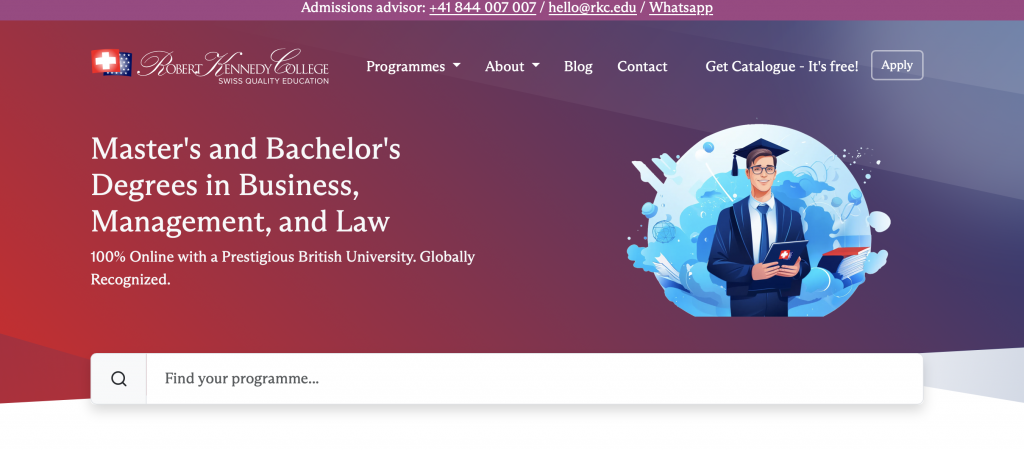
Robert Kennedy College has pioneered Swiss quality online learning since 1998. It offers rigorous but flexible learning programmes enhanced by state-of-the-art online e-learning technology. We always like to stay ahead and modern in our approach. So, here’s introducing a fresh, revamped look to our college website.

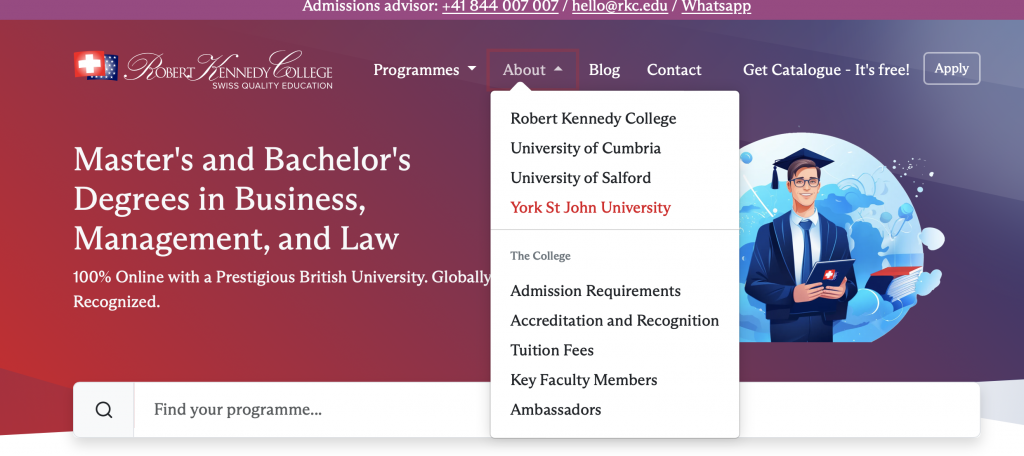
The user-friendly layout is welcoming, clearly laid out and interactive—the homepage links to programme details, features, and course catalogues. The quick search bar allows you to look for the programme of your choice, be it Project Management, International Business, International Commercial Law or the BA (Cons) programme. Information is available at one click.

The top bar provides links to contact our education advisor in real time through phone, email or WhatsApp.

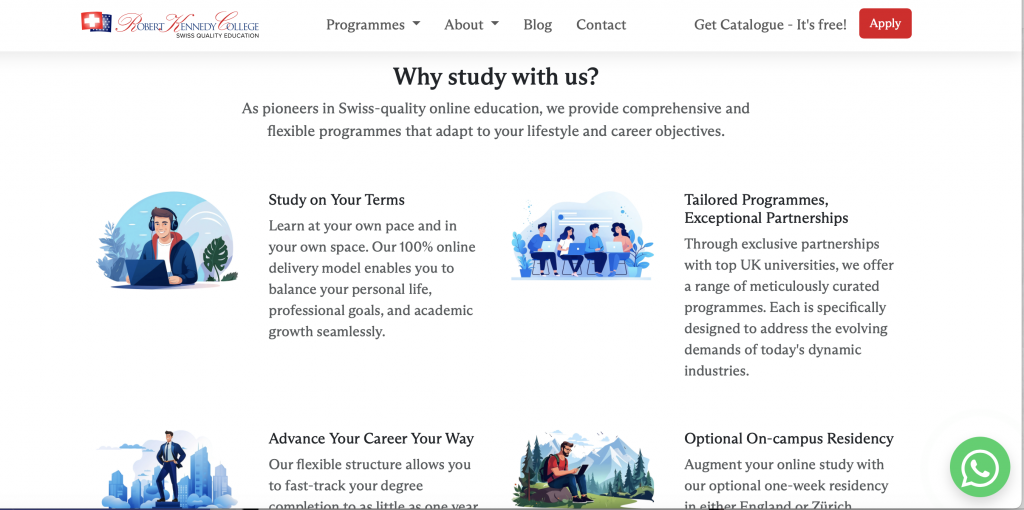
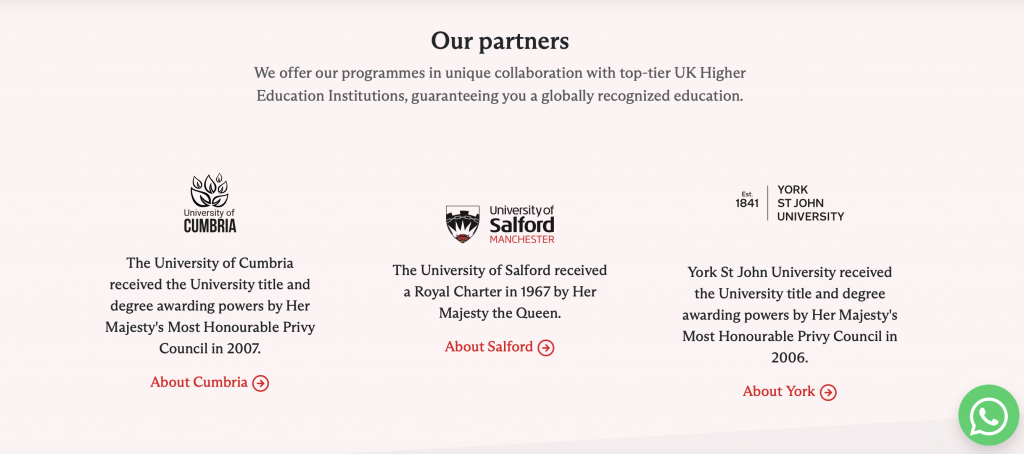
Further, you find an overview of why to study online with RKC. You can also find all information about RKC’s partnerships with three universities – the University of Cumbria, the University of Salford Manchester and York St John University.

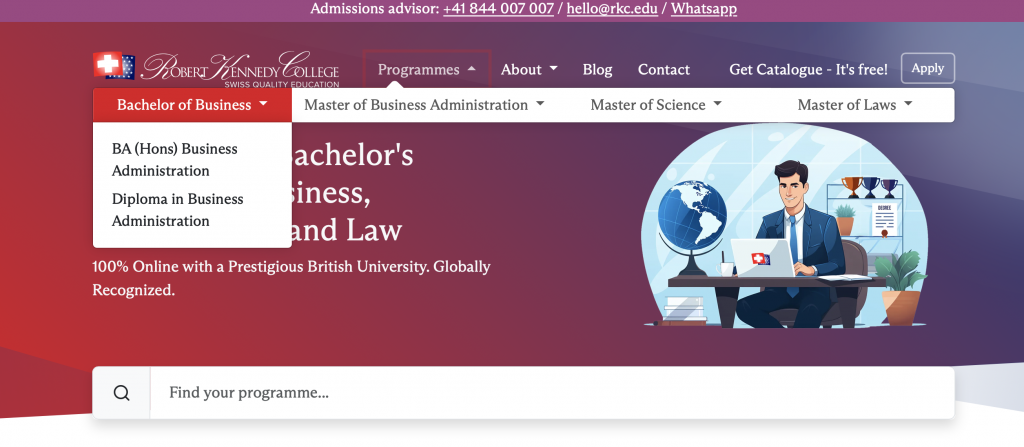
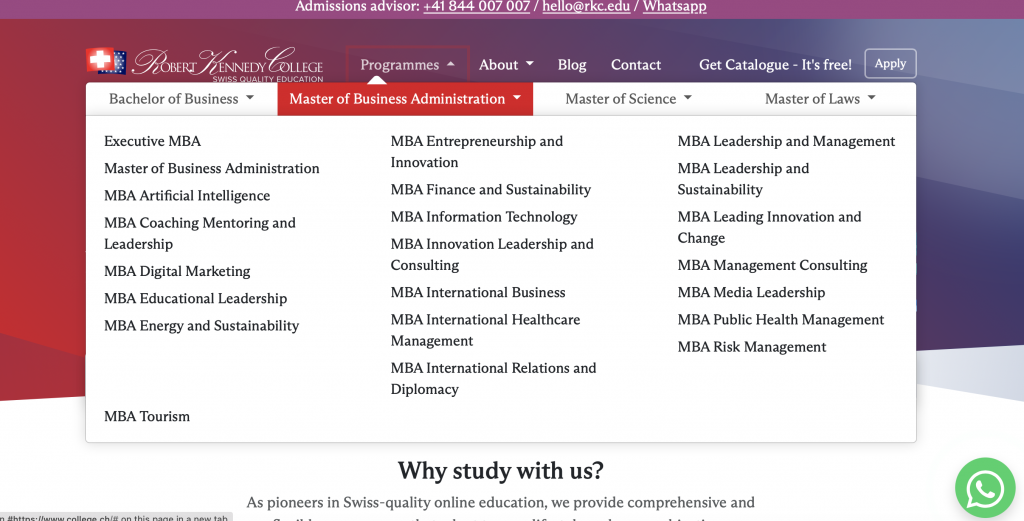
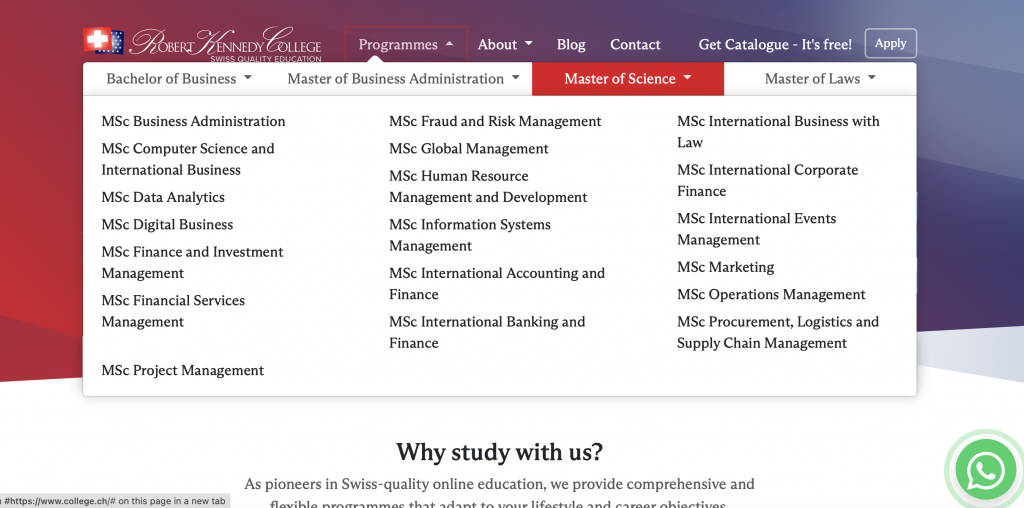
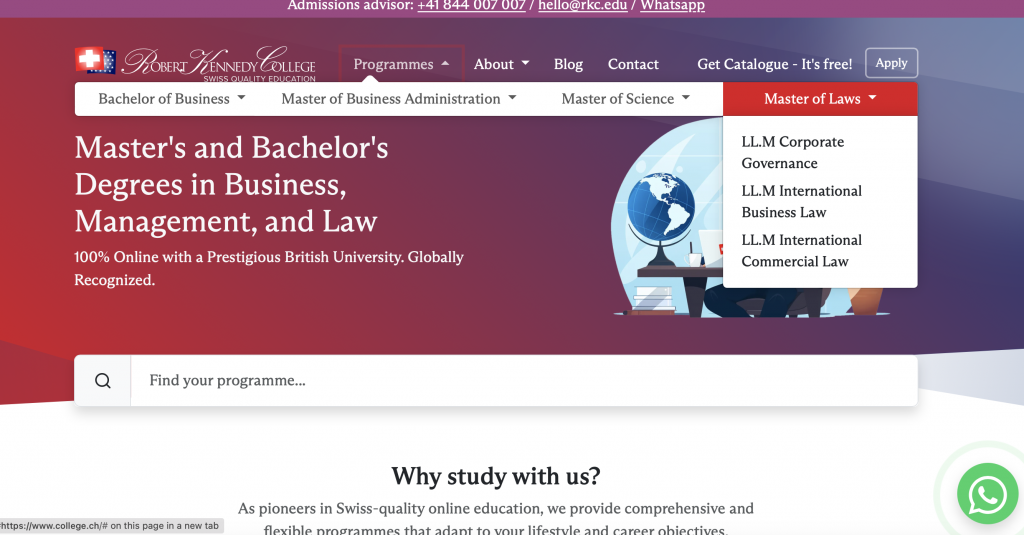
Each dropdown provides detailed information about the programmes RKC offers – Bachelor of Business, Master of Business Administration, Master of Science and Master of Laws.

Next, the ABOUT dropdown provides detailed information about Robert Kennedy College and its partners. Every student seeks information on the fees, accreditation and recognition, and admission requirements. This tab includes everything that you are looking for.

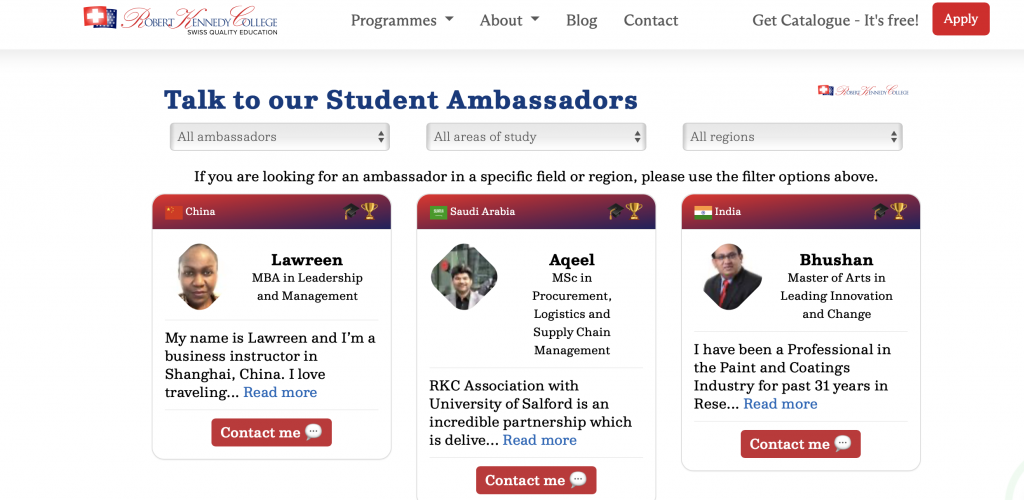
Another great feature you can access is the link to the Ambassadors page. Here you can chat with our ambassadors – current students or alums – to ask any question that you might have about our online Master’s or to hear about their experience of studying with RKC.

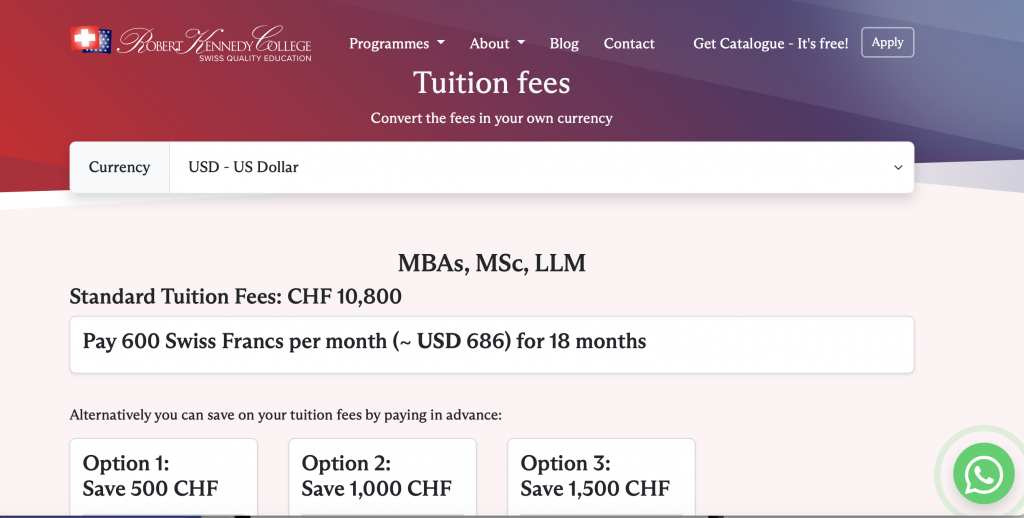
The fees page provides comprehensive detail about the fees, instalments and various options for payment. It lets you convert the fee structure into the local currency!

Remember to check out our blog link from the top bar, and for a quick chat with one of our education advisors, click on the WhatsApp logo on the bottom right of the page.

What do you think of this new look? Let me know your thoughts in the comments section!

Advance your career with a master’s degree in the modern job market. Here are FIVE reasons you should study for a master’s in 2023!

Today’s job market is highly competitive and challenging. To prove your metal, one has to exhibit why you outshine in the crowd of thousands of job applicants. Higher education has increasingly become necessary for anyone seeking career advancement. And in today’s dynamic environment, just a bachelor’s degree may not suffice to get the top jobs. A master’s degree in your specialization will help expand your knowledge base and experience required to make your next career move or get the promotion.

Photo credit: Unsplash.com

The benefit of a master’s degree to you in 2023

Everyone has their reasons to pursue a master’s programme. Here are some popular ones:

1. Shield against recession and job cuts

Once you equip yourself with master’s degree knowledge and skills, you level yourself above the rest of the employees. The employer will choose the employees who are better qualified and experienced should the situation of job cuts arises. One can better their chances of sustaining their jobs and ensure job security by creating value for the company.

One can better their chances of sustaining their jobs and ensure job security by creating value for the company.

2. Building a vast professional network

While studying for a master’s, one of the benefits is that you get to interact with like-minded professionals. One gets to know people from different cultures, intellects, and business acumen from across the world. The connections you make are made from the standpoint of mutual learning and growth, which usually are impossible to make at the workplace due to competition and professional jealousy. These connections last forever. 

3. Potential of earning a higher salary package

Depending on your field – a master’s degree usually means the potential of earning a higher compensation package. Being a master’s degree graduate, you can negotiate your pay package on your terms. Employers recognise the value you bring to the table and are willing to offer compensation dollars ($$) accordingly.

4. Better probability of promotions

Having a master’s degree betters your chances for that promotion at work by raising your bar to the top candidates running in the competition. So, if you are aware of any arising opportunity for promotions at your workplace in 2023, start your application for a master’s degree now.

5. Advanced knowledge

You maybe are the head of the department running the show for the company in sales, finance, supply chain, marketing, commercial law or artificial intelligence. One feels the need for new ideas to run a business efficiently and increase profitability by implementing new/better business processes. Beyond a point, one needs to learn management and leadership skills to be a better manager and effective leader. Such knowledge can be acquired by furthering your horizon with a master’s degree.

I can extend another reason for you to start a master’s programme in 2023 with the special fee promotion. You can now join a master’s programme with a deposit of just 500 CHF. Also, benefit from discounts up to 2,100 CHF. You can connect with our education advisors on WhatsApp for a live chat to learn about the application process for intakes starting in January 2023.

What is your reason for starting a master’s in 2023? Share in the comment section below, and get started with the next steps now!

#DILO (A day in the life of) a master’s student – Paul

Continuing our a day in the life of RKC student series, we asked some of our past and current students to share their thoughts and opinions, to give their feedback on how they handled the challenges of online learning. 

There is no better way but to learn from those who came before and see if what worked for them will help you become a better student! Hopefully, this will help you to make an informed decision..

An Introduction

Who are you, really?

I am Paul M.

Which programme did you choose and why?

The MBA programme. The MBA obviously has the essential business basics, that improves our ability as leaders with contemporaneous knowledge of current best practices combined with reiteration of essential skills which every leader should know. I chose RKC because of the convenience of an online degree and the fact that it partnered with quality UK universities.

The Study Plan

How did you plan to study each module, and what was the reality? How many hours did/do you have to put in each day/or in a week?

Robert Burns’ poem To a Mouse, (1786) includes the line “the best made plans of mice and men” which is interpreted that even the best made plans will go wrong…and they did. I set aside time each evening for course reading and the online availability made it easy when traveling. Over weekends, I was locked down on Sunday evenings until midnight, regardless. Each week required at least 12 -20 hours of study time to see any progress.

What part of the day did/do you find most suitable to study? (e.g. early mornings, lunch break, evenings, weekends?)  

Evenings and the occasional early morning.

How much time did you devote to each assignment?  

Each class has different requirements, so this is tough to quantify. In average each assignment (Paper/ report) requires around 40 hours of self directed study and another 20 in terms of prep and writing the paper. The dissertation is a whole different time management project and requires STRUCTURE, if you cannot be structured and meet / set deadlines this will be a challenge.

Photo credit: Canva.com

Travelling and Communication  

How did travelling impact your ability to study?  

If there was internet, I was on the site!

How were you able to interact with peers and/or professors given the time differences?  

Some direct messaging and interactions mostly on the forums. It was much more due to COVID.

A typical day as a master’s student  

What does a typical day as an Online Masters’ student look like for you?  

FIRST THING 1) Check forum posts

2) Check for any updates on syllabus and deadlines 3) Plan any activity for the day 4) Regular work day 5) Study one to two hours and engage on forum.

Photo credit: Canva.com

Any advice?  

Any advice you have for students to better plan their studies.  

Have a plan and work the plan. If you fail, reset and get back on the plan, learn to adapt to the challenges that life sends you. Above all have fun the end result is worth it.

I hope this blog has answered some of your questions, and please watch this place for similar blogs. So, if you have been thinking about doing a master’s degree and now understand how to study better for an online programme, look at our programmes and see if anything interests you.

You can also chat LIVE on WhatsApp with one of our Education Advisors for more information on all the programmes we offer, the application process, and answers to any questions you may have.

Getting ready for 2021

Phew! It is 2021! 2020 is finally over and behind us. After having an incredibly unique (and for many a traumatic) 2020, I am a little sceptical and at the same time joyous and hopeful of welcoming the new year.   

Well, let me first extend my warmest wishes to you, our readers, happy new year! One of the greatest joys of this season is the opportunity to say thank you and to wish you the very best for the New Year.   

‘Tis the season…  

So, what do you think 2021 will look like? Are you ready to embrace the new year as it still encapsulates certain uncertainties? Have you set any personal goals, professional goals, or academic goals for yourself? Because it is that time of the year when we sulk on unfinished resolutions or celebrate their achievement (I fall more in the former category than the latter 🙁) and look forward to new ones!   

In my opinion, it will be much more than just resolutions this year. People are frustrated with unfulfilled wish-lists, lockdowns, and fear of the pandemic. Emotions are running high; there will be no holding back, it could turn out to be a year where you tick off all the boxes (or most of).  

Here are the five trends you must watch out for in 2021:  

1. Shoppable TV and social media influencers   

Consumers will be able to buy anything they like, on the go and instantly!

With worldwide lockdowns, the retail industry saw a categorical change with the brick-and-mortar stores shutting down. Shoppers had to move online, and the businesses capitalised on every opportunity to grab consumer’s attention. Consumers will be able to buy anything they like, on the go, instantly, as they watch the advertisement on their favourite streaming channels, or a product recommended by their favourite social media influencer. I have personally experienced this; a tik-tok video made the CeraVe skincare products fly off the shelves within days. That is a powerful sales tool.   

2. Big data becomes bigger  

Big data is inexhaustible

As we rely more and more on online platforms for almost everything, from groceries to banking, to buying cars to education, the data is building up exponentially and is inexhaustible. There will be an increasing new need for data analysis and customer personalisation.  

3. Artificial Intelligence (AI)  

AI is predominantly the most significant trend to watch out for in 2021. With bigger data, better interpretations will be required to understand the world and the changing patterns of the consumers. In 2021, we are likely to see further sophistication in machine learning algorithms and tools.  

4. E-Sports  

Gaming is in line to become a multi-billion-dollar industry

Gaming is one of the sectors that was positively impacted by COVID-19. While other industries suffered losses, gaming has been trending and is in line to become a multi-billion-dollar industry by 2023. It is one of the top entertainment activities that people engage in, kids and adults alike.  

5. eLearning  

With the sudden closure of schools and universities owing to social distancing and self-isolation requirements in an attempt to flatten the COVID-19 curve, online learning became a necessity overnight and is here to stay. There are several benefits of online education, such as flexible learning and quality education offered at affordable prices.

Robert Kennedy College has been a pioneer in online education since 1998. When you decide to study with us, we promise you an excellent course curriculum, British education, Swiss quality, highly qualified faculty and a variety of Online master’s programmes to choose from. Start early and talk to our education advisors to find out how you can make the most of the new year 2021 though learning.

#DILO (A day in the life of) a master’s student – Beatrice

Through the #DILO series of blog posts we have been bringing you insights into the life of our master’s students, sharing their thoughts and opinions, ups and downs, and key learning points during their online studies. The whole idea behind this series is to make you aware of realities of online studies, and help you in decision making.  

This week we take a look at a day in the life of our MBA student Beatrice. Beatrice is an electronics engineer with over 19 years of experience working in IT. She is currently studying for the MBA in Management Consulting, offered through our exclusive partnership with York St John University, UK, and working for an American company as an IT Project Manager. Along with handling a full-time job and a master’s programme, Beatrice manages a busy household with a husband and two daughters. Here is an insight and some words of wisdom that Beatrice had to share from her own experience. 

With the MBA Management Consulting you gain an understanding of consulting techniques and develop a range of transferrable skills

An Introduction 

Which Uni are you studying with? 

York St John University (UK) 

Which programme did you choose and why? 

I chose the MBA in Management Consulting programme. It allows me to improve my knowledge and complete my profile as Project Manager. 

The Study Plan 

How did you plan to study each module, and what was the reality? How many hours did/do you have to put in each day/or in a week? 

Prepare a study plan and pick a time of the day that works best for you

I planned the modules to avoid overlaps and could make it as planned. It is important to allow at least four to five hours a day, 4 days a week. This can be increased to 5 hours a day when approaching assignment deadline. 

What part of the day did/do you find most suitable to study? (e.g. early mornings, lunch break, evenings, weekends?) 

Allow yourself enough time for each
assignment

What worked best for me were early in the morning and late in the evening, when there is no distraction (work, children, etc.) 

How much time did you devote for each assignment? 

Generally, 4 to 5 days. Sometimes more, depending on the topic. 

Travelling and Communication 

How did travelling impact your ability to study? 

When travelling, other activities make it more difficult to find the required hours to study 

How were you able to interact with peers and/or professors given the time differences? 

We used e-apps that allowed delayed interactions (email, campus portal, WhatsApp). 

A typical day as a master’s student 

What does a typical day as an Online Masters’ student look like for you? 

1. Spend 2 hours early in the morning, reading and watching class videos  

2. Spend 1 hour at lunch time to review and make some researches  

3. Spend 1 to 2 hours at late evening to write or complete researches 

‘Research’ is an important aspect of Master’s studies. Learn to research effectively.

Any advice? 

It is important to have:  

1. The support of your entourage  

2. A schedule that includes your studies, work and personal activities, even leisure. Follow it as much as possible  

3. A contingency plan 

Well indeed, incredibly helpful advice from Beatrice. A contingency plan not only saves you from an unpredictable situation but also helps you follow your study plan with confidence. To get you through the master’s studies we have a great faculty who are subject-matter experts, guide and encourage the students to achieve their potential.  

If you have been dreaming of joining a master’s programme or have had this personal goal to gain a higher education, now is the time! Take the valuable advice from our current students, gain from their experience, add your own unique study strategies, and make your own success stories! I would love to feature you one day on our college blog. 

Chat LIVE on WhatsApp with one of our Education Advisors for more information on all the programmes we offer, application process, and for information on discounts we might be offering at this time. 

Top 5 differences between an MBA and an Executive MBA. Which one is better for you?

Pursuing the master’s degree is a big decision in many people’s lives. Choosing which programme will be most beneficial for one’s career development can be nerve wrecking too. Because there are choices – too many choices! For example, one might decide to go for an MBA programme, however, there is a choice to pursue an Executive MBA (EMBA) too! As an aspiring student, which one should you choose? Let us explore the differences, pros and cons of both so that you can make an informed decision. 

1. Admission criteria 

One of the foremost differences between an MBA and the EMBA programme is the admission criteria. For most of the MBA programmes minimum experience required varies between 1-3 years. Sometimes, even fresh under-graduates can also apply for MBA programmes given a good academic record.  

On the other hand, an EMBA typically requires candidates to have on average 3 to 6 years’ work experience with at least 2 to 5 years of managerial work experience. Our current MBA students and alumni for example, possess on average 5 to 10 years of work experience, holding leadership and management titles in companies such as risk and quality managers, heads of sales, senior corporate trainers, marketing directors, lawyers, consultants, politicians and diplomats, company presidents and CMOs. 

2. Pace of study 

The MBA programmes are typically pursued on full-time or on-campus basis, and have very demanding schedules. They have more traditional and rigid course structures. An EMBA on the other hand, offers a more flexible study schedule, and are typically delivered in blocks (weekends, once a month, etc.) or online. The majority of the EMBA students are working professionals with busy work schedules. Thus, to optimize their time, EMBAs offer lecture sessions at rarer, but more intense intervals than their MBA counterparts. When done online, these really put flexibility at the forefront. 

 

3. Intensity of the programme 

While both programmes focus on the same core modules, the degree of intensiveness in both varies. For the EMBAs, I will use an analogy of a multi-vitamin supplement – a power packed mix of various vitamins all together in one. Similary, EMBAs are intensive, and one should be ready to absorb a lot of knowledge in a short period of time.  

A regular MBA programme however, spreads the modules over a period of time. The course material is widely distributed and thus is comparatively less intensive than EMBAs. 

Group of students at the Residency in Zurich (At the moment we are conducting Online Residency in light of Covid-19 restrictions).

4. Curriculum and focus 

In an MBA programme, since it accepts candidates with fewer years of experience, the focus is on teaching and developing management knowledge from the basics. It has a broader choice available in terms of the electives that a student can choose from. An EMBA programme, however, has a higher bar set in terms of experience from its candidates. While some of the core modules are same as an MBA programme, an EMBA programme has a more focused approach.  
 

Celebrating our Graduates – University of Cumbria

5. Financial implications 

An EMBA wins over an MBA programme any day when we talk about financial implications of both. Firstly, an EMBA candidate can continue their day jobs and get paid to support their education. MBA programmes with full-time study schedules make it more difficult for students to continue with their jobs. Secondly, since a large portion (or in our case, all of the programme) is studied online, one saves a huge amount of money in travel and living expenses. Thus, the return on investment on an EMBA is typically much higher than a regular MBA programme.  

Money matters..

There is of course the issue of programme cost – these vary wildly though, and you can find really expensive programmes in both EMBA and MBA settings. 

I hope the above provides a few points to help you make the distinction between an MBA and an EMBA programme. 

Robert Kennedy College offers online MBA programmes – which are much closer to EMBAs than they are to MBAs because of their flexibility and incredible value for money. We do that in exclusive partnerships with the University of Cumbria and York St John University. Check out the list of various MBA progammes that we offer and choose the one that best suits your interests and career.