Strategic management in the RKC MBA programme emphasizes not only analytical rigour but also the ability to interpret complex, interconnected business environments through multiple lenses. This blog by an Executive MBA student of Robert Kennedy College – Gohar Hovsepyan explores how modern strategy has expanded far beyond traditional models, integrating insights from behavioral science, data analytics, design thinking, and sustainability. By examining these unconventional yet increasingly essential disciplines, she aims to bridge the theory from the Strategic Management module with the emerging realities facing today’s leaders—where strategy is dynamic, human-centred, data-informed, and purpose-driven.
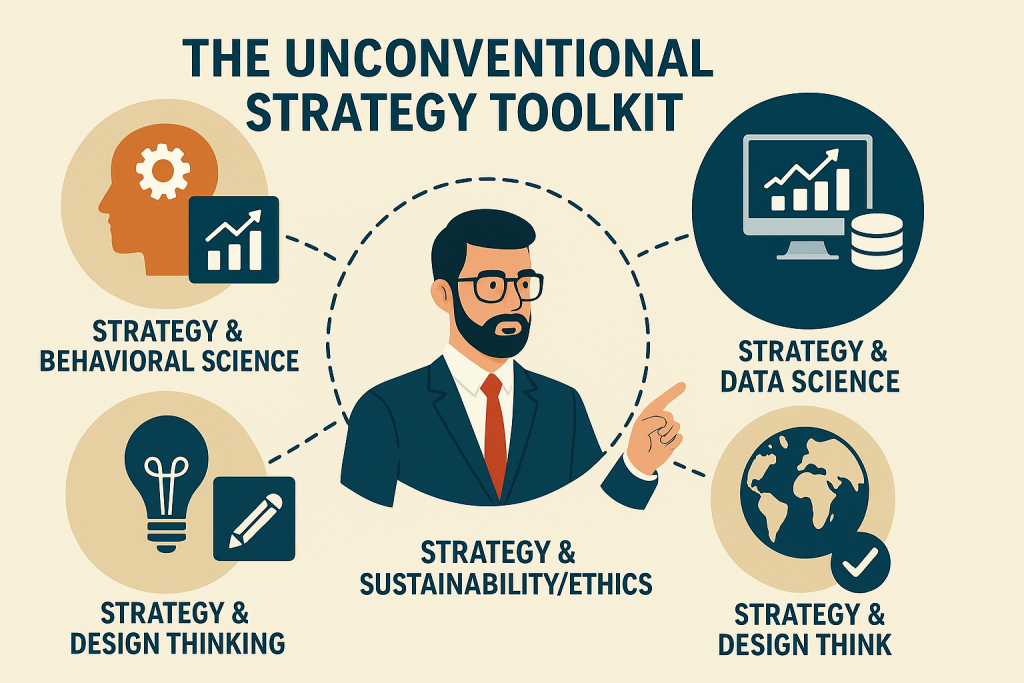
Strategic management, once viewed as a purely executive function, is undergoing a revolutionary transformation. For today’s MBA students and business leaders, understanding strategy means recognizing its innovative blend with disciplines far beyond traditional business studies. This evolution is crucial for navigating the complexity, rapid change, and interconnectedness of the modern global market.
The New Strategic Ecosystem
Traditional strategic models focused heavily on competitive analysis, internal resources, and static long-term planning. While these fundamentals remain important, contemporary strategic management is increasingly a dynamic, cross-disciplinary endeavor.

1. Strategy & Behavioral Science: The Human Element
The best-laid plans often fail due to human factors. This is where behavioral science—including psychology, cognitive science, and sociology—proves invaluable.
- Nudge Theory: Strategists are using principles like Nudge Theory (Thaler & Sunstein) to subtly guide organizational behavior toward strategic goals, improving everything from compliance to innovation adoption.
- Cognitive Biases: By understanding biases like confirmation bias or sunk cost fallacy, leaders can de-risk decision-making processes and foster more objective strategic reviews.
- Organizational Culture: Strategy execution is inseparable from culture. Behavioral science provides the tools to intentionally design the organizational environment to support strategic priorities, for example, by restructuring incentives to prioritize long-term value over short-term gains.

2. Strategy & Data Science: Precision and Foresight
The explosion of data has fundamentally changed strategic intelligence. Strategy is now deeply interwoven with data science, machine learning (ML), and artificial intelligence (AI).
- Predictive Analytics: ML models can forecast market shifts, customer churn, and competitor moves with unprecedented accuracy, allowing for truly proactive strategic adjustments rather than reactive ones.
- Real-time Strategy: Cloud computing and IoT (Internet of Things) enable strategies to be evaluated and adjusted in near-real-time based on live performance data, moving away from annual review cycles.
- Competitive Intelligence: AI-driven text analysis and sentiment mapping provide a deep, ongoing understanding of the competitive landscape, customer needs, and emerging technological threats.
3. Strategy & Design Thinking: The Customer at the Core
In a world defined by experience, Design Thinking has become a vital strategic tool, shifting the focus from “what we can build” to “what problems we can solve for the customer.”
- Empathy: Strategic exploration begins with deep customer empathy, using ethnographic research and observation to uncover unmet, often unarticulated, needs.
- Prototyping & Iteration: Strategy development is no longer a linear process. Design Thinking encourages fast, low-fidelity prototyping of business models and strategic initiatives, allowing for rapid failure and learning before massive investment. This minimizes the risk associated with bold strategic moves.
- Innovation Strategy: By framing problems as design challenges, organizations can generate genuinely novel solutions, leading to breakthrough innovations and the creation of entirely new markets (Blue Ocean Strategy).
4. Strategy & Sustainability/Ethics: Purpose-Driven Value

Modern strategy cannot ignore its impact on society and the environment. Environmental, Social, and Governance (ESG) considerations are no longer a regulatory footnote but a core strategic driver.
- Stakeholder Strategy: Moving beyond the shareholder primacy model, strategists are adopting a stakeholder view, recognizing that long-term value creation depends on balancing the needs of employees, communities, suppliers, and the planet.
- Circular Economy Models: Strategic innovation increasingly focuses on resource efficiency, waste reduction, and closed-loop systems, creating new efficiencies and resilient supply chains.
- Risk Management: Strategic oversight of ethical AI use, data privacy, and climate-related risks is now mandatory for corporate longevity and reputation management.
Key Takeaway for the MBA Strategist
The future strategist isn’t just an analyst; they are a synthesizer—a polymath who can speak the language of the psychologist, the data scientist, and the designer.
To excel in strategic management today, you must:
- Embrace Data Literacy: Understand how to frame strategic questions that data science can answer.
- Cultivate Empathy: Ground all strategic choices in a deep understanding of human needs (customers and employees).
- Practice Agility: Adopt an iterative, test-and-learn approach, treating strategy as a living hypothesis rather than a rigid blueprint.
The most powerful strategy is one that leverages the intelligence of multiple disciplines to create value that is not only profitable but also purposeful and resilient. Strategic management is no longer a department; it’s a mindset.
As this exploration shows, the strategist of the future must draw from a multidisciplinary toolkit—mirroring the holistic, systems-based approach championed in the RKC MBA Strategic Management module. Whether leveraging data for foresight, using behavioral insights to enhance execution, or applying design thinking to uncover new market opportunities, modern strategic management demands curiosity, adaptability, and critical reflection. Ultimately, strategy becomes most powerful when it blends analytical frameworks with human insight and ethical responsibility, enabling leaders to shape organisations that are competitive, innovative, and resilient in an ever-evolving world.